
By Sarah Guerrero Gorostieta
“HARD OF HEARING,” read the laminated signs that a young medical resident at Northwestern’s Feinberg School of Medicine strung around the necks of frustrated geriatric patients. “Repeat after me: ‘Doctor, nurse, you have to speak to my face,’” he gently coached. And so, they did, their demands for dignity traveling through the corridors of the gerontology ward.
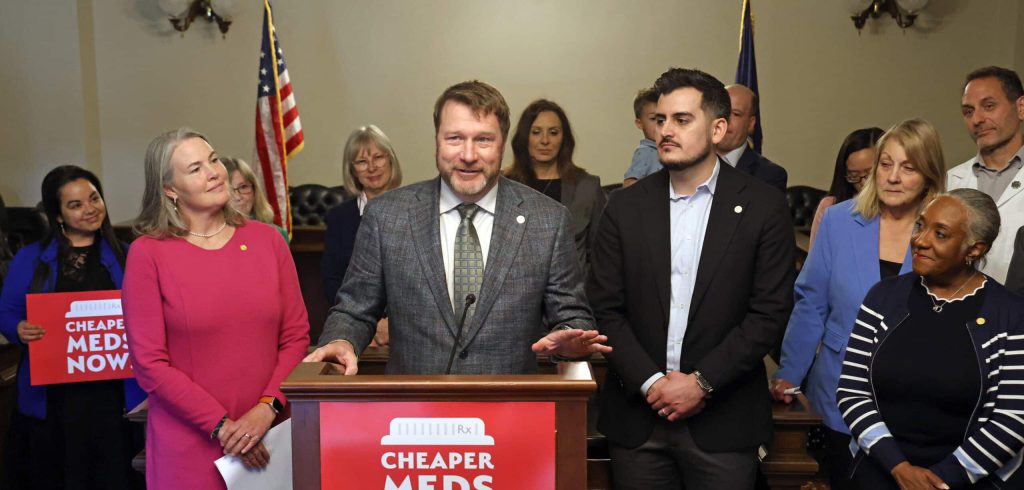
That young resident was Dr. Matt Longjohn, K ‘93, 32 years ago; and today, as Michigan’s 40th State House District’s representative, he continues to empower those who feel unheard.
Longjohn’s path to public office wasn’t linear. He witnessed growing distrust in healthcare institutions, battled defamatory smear campaigns from political opponents, and endured an unsuccessful 2018 bid for Congress. However, with an M.D. and M.P.H from Tulane University, he now serves as the only physician in Michigan’s legislature, fueled by his passion for healthcare advocacy that took root during his time at Kalamazoo College.
Born and raised in Kalamazoo, Longjohn embraced the K Plan as an undergraduate. He majored in biology, studied abroad in Strasbourg, France, and interned in the medical field. His curiosity drove him to take full advantage of experiential and international learning, shaping a versatile skill set with a broad sense of purpose that would guide him through an ever-evolving career.
When we connected for an interview, Longjohn wore a distressed purple hat branded with a yellow Louisiana State University logo—a nod to where he spent a quarter completing his SIP, which focused on developing a behavioral model of ischemia in rats.
“K planted the seeds of my passion for healthcare,” Longjohn explained, but it was the year after graduation he spent backpacking across the world that exposed him to the possibilities beyond clinical medicine. “The poverty I saw in Bangladesh and health needs I saw in Thailand really solidified I wanted to pursue a career that spanned clinical medicine, public health, public service focused on policy,” he said.
Those seeds flourished as Longjohn pursued dual degrees at Tulane and completed his medical residency at Northwestern. In 2004, he began serving as the founding executive director of the Consortium to Lower Obesity in Chicago Children (CLOCC); and as a faculty member at Northwestern, he taught courses like “Violence as Public Health Problem” and others focused on healthcare advocacy topics.
In 2005, Longjohn and his wife, Valerie Miller—whom he met in the first grade and who is now the CCPD Director at K—settled in their home state of Michigan with their two sons. For the first three years, he commuted three hours between Chicago and their home in Vicksburg, Mich. and continued running the CLOCC from their family farm. Later, as National Health Officer for YMCAs nationwide, airplanes became his traveling office. He averaged 130 flights a year for over a decade as he worked to engineer health across the country and managed about $100 million in research and grants focused on disease prevention and healthcare accessibility.
Yet, when public health came under attack from the rhetoric of the first Trump administration, Longjohn realized research, funding, and fact checking alone couldn’t protect vulnerable communities from the spread of medical misinformation. His wife challenged him to act. After attending the 2017 Women’s March in Washington, D.C., Miller posed a pivotal question: “What are you going to do?” Initially, she envisioned protesting, canvassing, and phone banking together. But as the administration amplified misleading healthcare narratives, Longjohn was forced to confront the dangerous implications for his work.
Feeling increasingly ignored, Longjohn sent a white paper to the Democratic Party, urgently pleading for someone to listen and act before it was too late. Shortly after, while in Washington D.C., a representative from the Democratic Congressional Campaign Committee approached him. She had read his paper and asked, “Have you ever thought about running for office?”
“I came home and laughed about it,” Longjohn recalls. “But around that time, the Republican members of the U.S. House introduced policies to repeal and replace the Affordable Care Act and suddenly, everything that I had spent 25 years working on related to prevention was on the chopping block.”
Closer to home, Southwest Michigan Congressman Fred Upton proposed an amendment that would have stripped Medicaid from 600,000 Michiganders. As Longjohn weighed the logistics of running, like fundraising, family, and professional obligations, his mounting disillusionment with the system clarified the real question: Why wouldn’t I run?
In 2018, Longjohn challenged then 32-year Republican incumbent Upton for his seat in U.S. Congress. Upton’s campaign weaponized technicalities about medical licensure to discredit Longjohn’s credentials, branding him a “fake doctor.” The attacks on a career dedicated to improving America’s quality of life, values Longjohn spent decades cultivating, hurt him most. Longjohn came closer to unseating Upton than any Democrat in years but ultimately lost. Marked by partisanship and the tarnishing of his reputation from the defamatory claims, Longjohn was forced to reassess his position in the health community. However, “losing the election was the start of my political career,” he stated.
For Miller, her husband’s first run for office was not an easy decision. She admits she wasn’t initially thrilled about the idea of campaigning for Congress, wary of the toll it might take on their family. But as she watched him canvass the district, sharing vulnerable, personal stories to connect with voters, then tackle COVID-19 as the head of the Protect Michigan Commission under Governor Gretchen Whitmer, and still come home exhausted, yet passionate about his work, her perspective shifted. By the time Democrat Christine Morse announced she was stepping down as State Representative for Michigan’s 40th House District, Miller was the first to encourage Longjohn to run again.
On Nov. 6, 2024, Longjohn secured a victory over his opponent, Republican Kelly Sacket, with 57.4 percent of the vote. Marking a significant milestone in his political career, Longjohn assumed his first elected office, notably serving as the only physician in the legislature.
Just over four months after his victory, in the fluorescent-lit basement of the First United Methodist Church in downtown Kalamazoo, 10 gun violence prevention advocates flipped through pamphlets, waiting for their newly inaugurated state representative. Another 10 joined via Zoom.
“I’m here because I feel like I’m flailing and no one is listening,” one woman admitted. “I’m looking for Rep. Longjohn to tell us what to do next.”
Longjohn arrived halfway into the meeting, rushing in after his daily commute from the Michigan State Capitol in Lansing. He launched into stories from his medical residency, recounting ambulance rides with gunshot victims, sharing the case of a 13-year-old boy whose wounds left a lasting impact. The room, caught between outrage and grief, softened.
“We have to fight gun violence like a chronic disease,” he told the group, outlining a strategy of marginal improvements, local focus, and bipartisan common ground. “You can’t do everything, but you have to do something.”
Dr. Aran Kadar, Longjohn’s former medical school roommate, spoke to his savvy ability to prioritize competing healthcare priorities, remembering how, even at the start of his career, he wrestled with the decision to focus on obesity prevention or gun violence. “He saw that both sides of the political spectrum were invested in childhood health,” Kadar explains. “He recognized it as a strategic entry point for broader health initiatives and bipartisan collaboration.”
Now, the freshman legislator is poised to tackle gun violence, minimum wage, paid sick leave requirements, and other pressing issues. Miller, who has watched her husband bridge the worlds of medicine and policy for years, sees his opportunity to have an impact as an insider. “He was frustrated always being on the outside. Now as a legislator, he has the chance to shape change from within.”
She also sees Longjohn as a consummate K grad and his guiding curiosity as a blueprint for today’s K plan. “Your major is just one piece of the puzzle.” Matt studied biology and went to medical school, but instead of becoming a clinical doctor, he focused on equity and systems. Biology gave him a starting lens, but the key is to stay open and follow your curiosity—you might find a path you never expected.”
That same curiosity, which distinguished Longjohn as one of America’s top healthcare innovators—an honor awarded by the Obama administration—now influences his policy work. As a newly appointed member of the Appropriations Committee, Longjohn oversees funding allocations within higher education and human services. His days are packed with navigating the legislative process, drafting bills, and finding his footing in a shifting legislative landscape where Democrats hold less power than in previous years. His schedule overflows with constituent events and coffee chats with House colleagues — and the work always stretches beyond office hours.
Still, in a system defined by political gridlock, Longjohn remains rooted in the mission that led him from the clinic to the Capitol. “I’ve spent my entire career focused on improving the health of others,” Longjohn says, “and I’ll find a way to bring my brand of healthcare to Michigan and improve the quality of life of ten million Michiganders.”
Leave a Reply